
As every year ends, athletes contemplate their futures and some have to think about retirement. An example is Cristiano Ronaldo, one of the greatest footballers in the modern era, who raised the topic of hanging up his boots earlier this month. The Portuguese striker and ex-Manchester United and Real Madrid legend turns 41 in February, yet is still scoring in the Saudi Pro League, so why stop? Other near-retirees in other sports like LeBron James and Aaron Rodgers are facing the same retirement dilemma, but will they get it right or will they be ‘unretiring’ multiple times, a strategy that history shows is not the best move.
A classic case of a messy retirement is Michael Jordan who left the Chicago Bulls in October 1993, just after he’d led them to a third consecutive NBA title. His basketball career was over.
Well, yes, except that Jordan had just been traumatized by the murder of his father, a tragedy that led him to switch sports and sign for the MLB’s Chicago White Sox - James Jordan Sr’s dream had been for Michael to be a baseball pro. But this move didn’t work. Jordan only played in the minor leagues and he retired from baseball to return to the Bulls for the 1995 season.
Amazingly, after another three successive Bulls titles, he said goodbye again to basketball in 1999 aged almost 36. He became a ‘suit’ - director of operations for the Washington Wizards. Somehow, the playing itch started again and, by September 2001, he was playing for the Wizards, justifying this broken promise by donating his salary to 9/11 families. There was no return to glory though (although he did score his 30,000th NBA point) and Jordan’s final retirement came in 2002.
For a man of such on-court certainty, his retirement was chaos. Jordan missed the adrenaline and couldn’t find a new purpose in his life. It’s not a unique story - fabled quarterback Brett Favre and superstar swimmer Michael Phelps are still struggling for some of the same reasons.
Favre retired from the NFL three times: firstly, from the Green Bay Packers in 2008 claiming “I don’t think I’ve got anymore to give”, but changed his mind to play one season with the New York Jets. He called it quits again in 2009, only to immediately re-appear with the Minnesota Vikings. In three seasons of ‘un-retirement’, Favre played 47 games and threw 71 touchdowns before finally giving up at aged 41 in 2011.
Meanwhile, Phelps told everyone in 2012 that he was worn out after a glittering career full of world championship victories and Olympic golds. Less than two years later, he announced his return and won another five gold medals at the Olympics in Rio de Janeiro to take his final total to an astonishing 23.
But both Favre and Phelps found the transition to life without elite competition very difficult. At first, commentators declared that Favre’s post-career unhappiness was due to how his Green Bay career ended – he felt the team moved too quickly to get rid of him – but even reconciliation in 2015 when he was inducted into the Packers Hall of Fame didn’t turn his life around. Controversies, especially surrounding money, had emerged and recently he was diagnosed with Parkinson’s disease. True contentment remains out of reach.
Post-retirement, Phelps was torn apart with mental health issues that his sporting career had helped him gloss over. He had long suffered from ADHD (attention deficit hyperactivity disorder) and, before he retired aged 31, he admitted to once contemplating suicide. No longer a full-time swimmer, he had to address his feelings of depression from a different and permanent perspective. Part of his retirement ‘cure’ is to be a mental health advocate.
Women retiring from top-level sport have the added question about when to have babies. World tennis No 1 and Grand Slam winner Kim Clijsters gave up the game in 2007 to marry and have a child. Two years later, the Belgian returned, but then stopped again so that she could be with her daughter. Her second comeback in 2020 was over seven years after her second retirement – she said returning to training improved her mental health. But two years later, the need to be with her family finally ended her 20-year pro career for good.
For some, it’s avoiding injury that drives the decision, but again mistakes can be made. Look at boxers who mistakenly return to the ring. When Mike Tyson fought again last December at the age of 58 (a full 20 years after his last real bout), there were major concerns about future brain damage – let’s hope the fears prove unfounded. Muhammed Ali’s case also comes to mind - there was no definitive proof that his boxing career and his Parkinson’s diagnosis were related, but many medical experts say that, if boxing didn’t cause it, then it may well have accelerated it. Ali retired twice and was still fighting at age 39.
This year, one boxer got the retirement decision tragically wrong. The 28-year-old Irish fighter John Cooney suffered a brain haemorrhage after a comeback fight in February and later died. Cooney was not a household name, but this tragedy underlines why boxers - and athletes in general - should retire before their health suffers.
Many high-performance athletes are so decisive in their sports, yet too often at a loss about the right time to walk away - shouldn’t this be part of a lifelong plan, not a confusing surprise. How will the next wave of stars do when it comes to ending a great career?
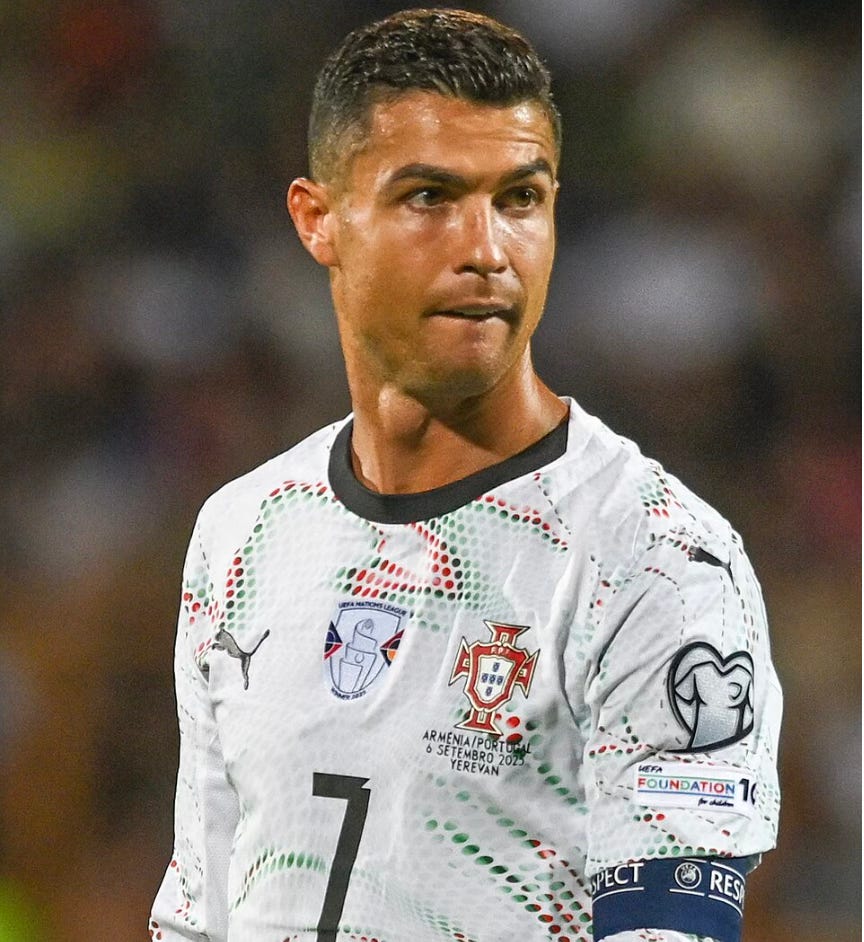
Cristiano Ronaldo (pictured above) could bow out in 2026 after an unprecedented sixth FIFA World Cup or when he scores his 1,000th goal (he recently passed the 950 mark). He may be joined on the sidelines next year by Aaron Rodgers who will turn 42 as a Pittsburgh Steeler before the end of this NFL season; LA Laker LeBron James whose 41st birthday is during his 22nd NBA campaign; and Justin Verlander and Max Scherzer (both with two World Series titles to their names) who are among several active pitchers over 40. All these men are ready to stop at the top, but they can’t all win a championship and then retire.
NFL Hall of Famers John Elway, Peyton Manning and Michael Strahan all won Super Bowl rings and then said goodbye for good. New York Yankees’ greatest player Joe DeMaggio won three World Series and immediately stepped away from baseball aged 37. Plus, he went on to marry Marilyn Monroe in retirement. All four found successful post-playing careers – is this a coincidence?
In some sports, the best athletes can now slide into retirement. Martina Hingis’s sparkling early tennis career of seven Grand Slam singles titles ended in 2003 at age 22 - she sited injuries. In 2005, she was back, but this two-year return ended with a drugs suspension. It wasn’t until a second ‘unretirement’ in 2013, that she realised that doubles tennis, not singles, was fun and less taxing on the body. She won 10 Grand Slam doubles titles before final retirement at 37. Masters tennis for the over 35s is now a surefire way to ease into the end of a career.
The same is true for professional golfers who can play competitively into their 60s and still earn millions in prize money on seniors tours. Injuries are still their nemesis, but even Tiger Woods, who turns 50 in December and whose body is half-broken, is tempted to play on the Fat Belly Tour (rather than the younger men’s Flat Belly Tour) to begin his life post-elite competition and the fans love it.
In the end, retirement by a talented athlete is usually determined by earnings, legacy, family and health and ‘unretiring’ is too often a bad decision. But there’s always an exception that breaks the rule, an athlete whose career extends beyond all the advice and reason, someone who can’t seem to retire, let alone ‘unretire’.
Meet Kazuyoshi Miura, aged 58 and the oldest active professional footballer in the world. ‘King Kazu’ has played in Brazil, Portugal, Croatia, Australia and Italy as well as his homeland of Japan and also 89 times for his national team while winning many trophies. He is in his 40th consecutive pro season, playing now in a fourth-tier Japanese league, and still having fun. Who knows when he will call it quits.
Even in a contact sport where injuries are numerous, Miura has put his ego aside and found a level of competitive football that his body, his legacy, his wallet and his family can enjoy. If only it was so easy for everyone else.
Ross Biddiscombe is struggling with a decision about retiring as a sports journalist after many decades - he will begin a series in the New Year about the 2026 FIFA World Cup. Please send this post as a Christmas gift to a friend and help extend his career 😱 🎅🏻